
An intelligent heat control hair straightener OEM uses advanced sensors, microprocessors, and high-efficiency heating elements (MCH or PTC) to precisely regulate temperature in real time. By integrating PID control logic, these devices ensure consistent styling performance, minimize hair damage, and feature safety mechanisms such as NTC monitoring and auto shut-off.
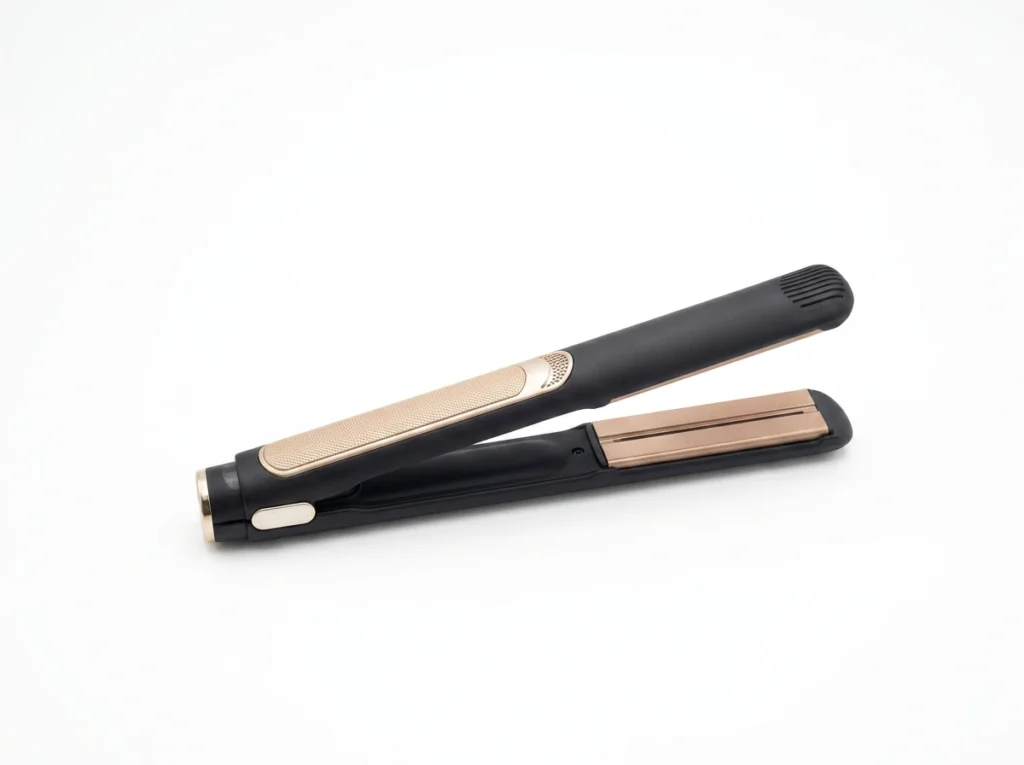
What Is an Intelligent Heat Control Hair Straightener OEM?
An intelligent heat control hair straightener OEM refers to a specialized manufacturer that produces private-label styling tools equipped with active temperature regulation systems. Unlike basic models, these systems focus on thermal stability—the ability to maintain a set temperature even when the plates lose heat to damp or thick hair.
Key Technical Components in OEM Sourcing:
Digital Thermostats: High-resolution control for precise user settings.
Microcontrollers (MCU): The “brain” that executes complex heating algorithms.
Premium Heating Elements: Advanced MCH (Metal Ceramics Heater) or self-regulating PTC.
Redundant Safety Modules: Multi-layer protection for global compliance (UL, CE, RoHS).
The Science of Precision: How the Thermostat Regulates Heat
A professional hair straightener thermostat regulates heat through a closed-loop feedback system. It utilizes an NTC thermistor to sense temperature changes 50-100 times per second, a microprocessor to process data using PID algorithms, and a power controller to adjust energy input instantly, maintaining a constant temperature within a ±1°C to ±3°C range.
The Technical Engine: PID Control & NTC Sensing
In the premium OEM sector, “intelligent” refers to PID (Proportional-Integral-Derivative) control logic. Unlike traditional on/off thermostats that cause wide temperature swings, PID logic allows the device to “predict” heat loss and adjust power incrementally.
Step 1: High-Frequency Sampling: An NTC sensor embedded directly beneath the plate monitors thermal load every few milliseconds.
Step 2: Instant Compensation (Heat Recovery): If a temperature drop is detected, the MCU triggers an immediate power surge. In high-end OEM models, “Heat Recovery” takes less than 2 seconds, ensuring consistent results from the first stroke to the last.
MCH vs. PTC: Choosing the Right Heater for Your Market
MCH vs. PTC: Choosing the Right Heater for Your Market
MCH heaters offer faster heating (under 30s) and superior temperature stability (±2°C), making them the choice for professional salon brands. PTC heaters are more cost-effective and inherently self-regulating, ideal for mass-market retail products.
Feature MCH (Metal Ceramics Heater) PTC (Positive Temp Coefficient)
Heating Speed Ultra-Fast (15s – 30s) Moderate (60s – 150s)
Temp Stability High Precision (±2°C) Medium (±5°C – ±10°C)
Energy Efficiency 20–30% More Efficient Standard
Lifespan Long (Industrial Grade) Moderate
Ideal For Professional Salon / Premium Brands Budget / Mass Market Retail
Safety First: Over-Heat Protection Mechanisms
Safety First: Over-Heat Protection Mechanisms
Overheat protection mechanisms use NTC sensors to detect abnormal heat spikes and a thermal fuse to physically cut power if temperatures exceed safe thresholds (typically ~240°C), preventing device damage and user injury.
Standard Safety Features for B2B Compliance:
NTC Real-time Monitoring: Prevents “thermal runaway” by detecting PCB or heater failures.
Auto Shut-off (Sleep Mode): Professional models typically shut down after 30 to 60 minutes of inactivity. Some high-end tools like ghd enter sleep mode after just 10 minutes for maximum safety.
Dual Circuit Protection: Separates the control circuit from the heating circuit to ensure the device fails safely if one component malfunctions.
Why Intelligent Heat Control is Vital for Your Brand
Product Differentiation: “Consistent Heat” and “No Heat Damage” are the top-ranking selling points in the 2024-2025 market.
Reduced Returns: Precise PID control eliminates the “hot spots” that burn hair, significantly lowering customer complaints and defect-related returns.
Higher Profit Margins: Premium features (MCH + Smart LCD) can command 35-60% higher wholesale pricing compared to basic PTC models.
FAQ Section
Q: Why does my straightener’s temperature fluctuate?
Answer: This is usually due to a lack of PID control or a slow-reacting PTC heater. Professional OEM products solve this with high-speed MCU feedback.
Q: Is 450°F (230°C) safe for all hair?
Answer: No. While thick hair may need 410°F-450°F, damaged or fine hair should stay between 250°F and 300°F.
Q: What certifications are mandatory for the US/EU?
Answer: You must ensure your OEM partner provides UL/ETL for North America and CE/RoHS for Europe.
Explore SINOXA sourcing resources
Compare our hair styling tools, review OEM/ODM project requirements and quality control information, or send your model and market requirements for a quotation.